
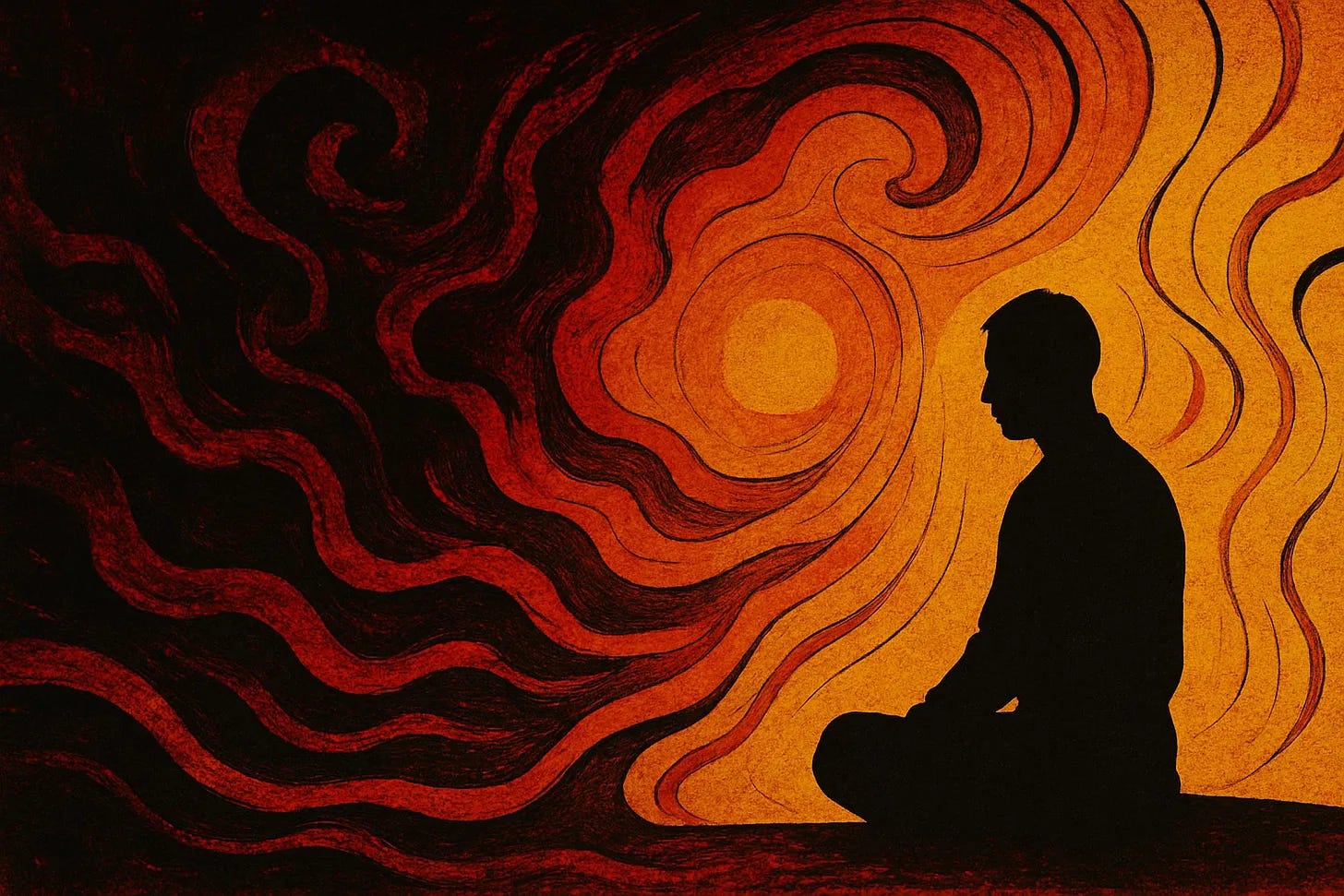
The chief way that we can court the Descent, invite the Below to become more manifest in our lives, deepen our experience of it, and eventually discover its elixirs, is to break down the protective wall built by the ego-self in an attempt to keep us safe. I imagine that most readers of this book have already entered into an awakening process of some kind or another, or at least have tasted enough to know that those walls the ego perpetually keeps us ensconced in can at times be lowered. Sometimes this happens spontaneously, sometimes intentionally; sometimes it’s over in a flash, sometimes it lasts for a long time.
However it happens, the lowering of the ego’s reality-walls opens up an infinite number of possibilities for how reality is experienced or how it manifests. You might already be quite familiar with practices that can reliably drop the wall and allow you to experience the Above — perhaps techniques that elicit awareness, spaciousness, emptiness, bliss, tranquility, or something similar. One of the most significant lessons in one’s Descent is discovering what kinds of tools or practices allow the Below to manifest.
I like to refer to such ego-wall-lowering techniques as psychedelic. Etymologically speaking, this word includes the Greek for “mind” or “soul” (psyche) and for “visible” or “manifest” (dêlos). So, a psychedelic could be anything that makes the deeper aspects of the psyche visible or manifest. Everyone will, of course, think of psychedelic drugs first. Personally, I have only done psychedelic drugs a few times — in college and for recreational purposes — and I quickly decided that it wasn’t for me. But, my studies of the use of hallucinogenics among shamanic cultures and conversations with some psychonaut friends has led me to have an appreciation for how powerfully these substances can knock down that reality-wall and evoke profoundly imaginal experiences.
However, while psychedelic drugs can reliably breach the ego’s defenses, I would strongly urge caution because these drugs are potentially unreliable in what kind of experience they plunge you into on the other side of that wall. As a beginner using such drugs, there’s often no telling what will happen. You might be thrust into an experience of the Above or the Below, you might experience extreme bliss or terror, you might experience sublime spiritual states or hellish nightmares. Drug-induced psychedelic states can potentially be therapeutic, but they can also cause irreparable psychological trauma to the journeyer.
Thankfully, with the clinical usage of these compounds in therapeutic environments, we have found that the nature and intensity of psychedelic experiences can be much better controlled with careful attention to “set and setting.” Even so, in speaking with friends who engage regularly with psilocybin, ayahuasca, 5-MeO-DMT, MDMA, and related substances to periodically propel themselves beyond the reality-wall for purposes of spiritual growth, they invariably tell me that their psychedelic sessions are unpredictable and that they need to do a ton of other practices in between sessions in order to integrate their experiences.
If after careful considerations of the risks you decide to use psychedelic drugs to enhance your experience of the Below, then that’s your own choice. Remember the principle of spiritual sovereignty. Fortunately, however, there are plenty of psychedelic practices (to use the more expansive definition of the term) that don’t involve drugs of any kind. Many of these practices are long-established parts of certain religious, spiritual, and cultural traditions, and many of them are already well known in contemporary Western spiritual circles.
On the more intensive end of the spectrum are practices that normally take place within retreat settings, including fasting, vision quests, meditation retreats, long-term sensory deprivation (e.g., so-called “dark retreats”), and so forth. Such intensive experiences can produce visions, revelations, and mystical experiences that are every bit as powerful as any drug. These also have the same downsides of being potentially unpredictable and overwhelming. Again, if you decide to engage in intensive practice in retreat settings, do so with discretion, under skillful supervision, and paying close attention to grounding and integration.
However, there are also many highly psychoactive techniques that can be practiced more regularly as part of your daily routine, which means that, on the whole, they will be more easily integrated. I’m thinking here of all sorts of different meditations, breathwork, mantras, yoga, qigong, visualization, prayer, active imagination, automatic writing, dream journaling, lucid dreaming, shamanic journeying, drumming, dance, ecstatic movement, and other trance-inducing techniques. When practiced in high daily doses, these can be every bit as psychedelic as drugs or retreats, and your experiences can also be just as powerful. When practiced in more moderate “dosages,” these can be safer and easier to integrate than the more intensive options. If your daily dosage drops even lower, these practices may become inert, devoid of any kind of psychedelic power at all. In my view, this flexibility is a great advantage. Particularly when combined with grounding practices, this gives you some power to control the intensity of the experiences you are cultivating.
During my three-year Awakening from Below process (which, again, should not be thought of as normative), I figured out which practices worked for me personally and administered them at the maximum dose that I could handle in order to maintain a high psychedelic intensity. In general, I practiced about 4.5 to 5 hours per day of a blend of seated meditation, walking meditation, yoga, qigong, and drumming-assisted visualization. This schedule allowed me to immerse myself in the Below while also maintaining healthy integration with the everyday life of family, work, and other obligations. I continually tweaked the blend of practices as my experiences shifted, and occasionally backed off when I wanted to more carefully navigate difficult territory.
What works for you, no doubt, will be different than what worked for me. My main advice is to always prioritize integration and balance. If you’re ever feeling like things are unsafe or unsustainable, back off and increase your practice of grounding. In a pinch, it is always a good idea to take a break from all psychedelic practices altogether, and to prioritize grounding until you get your footing back.