
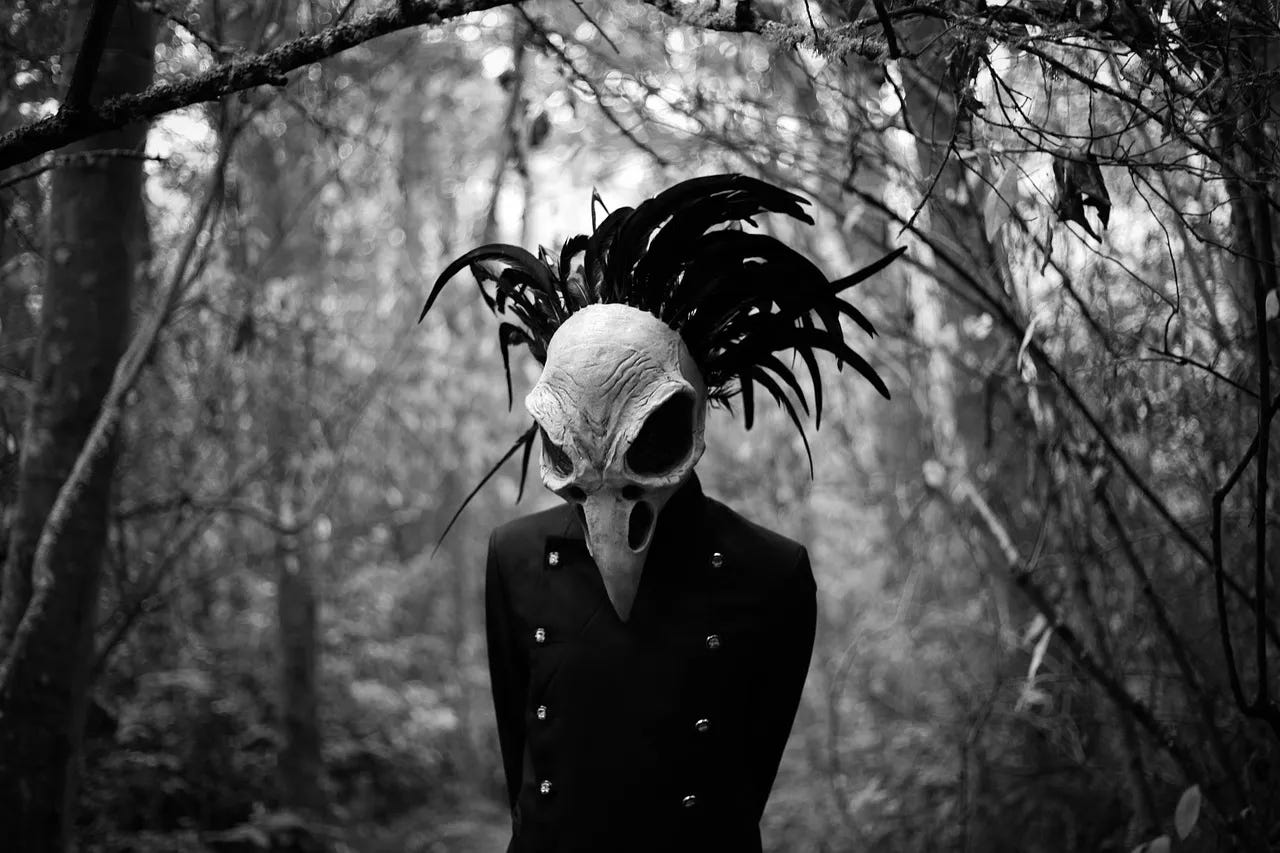
For most people, the first clear calling of the Below comes in the form of “imaginal” phenomena, a term popularized by the scholar Henry Corbin. Experientially, the term “imaginal world” is referring to a category of experience that is distinct from rational thoughts, emotional states, and even mystical experiences of the nondual or heart-opening variety. Despite the similarity between the words, the imaginal world is also quite distinct from the ordinary imagination you might use when daydreaming or playing make-believe.
Corbin offers a description of the imaginal in his article titled “Mundus Imaginalis or the Imaginary and the Imaginal,” which is freely available online. Other works that have greatly influenced my thinking on this subject include Cynthia Bourgeault’s 2020 book, Eye of the Heart: A Spiritual Journey into the Imaginal Realm, and also Rob Burbea’s talks on Soulmaking Dharma, discussed in the previous chapter.
I’ll be using my own language here in this chapter, but I think all of these authors would agree with me that imaginal phenomena are images, archetypes, symbols, and events that are characterized by strong emotional charge, density of meaning, and transformative power. Imaginal phenomena appear to us as autonomous, independent entities or forces, but yet somehow at the same time are deeply familiar, like they are mirroring parts of our psyche back to us in external form. When unpacked and engaged with, they reveal surprising and subtle connections between different types of experiences and events across time and space. They have an uncanny way of connecting our thoughts, memories, dreams, and other inner experiences with manifestations in the material world. Crucially for our purposes in this book, they are also the most immediate and effective gateways to the Below.
Rather than laying on more abstract descriptions, let me relate to you an example of an imaginal phenomenon so you can get the flavor. My friend Jeff Richards is an artist in Denver, Colorado. His main artistic practice is working with paint and thread against wooden frames to create stunning three-dimensional imagery. He writes a periodic blog called Hexagon Art, in which he described a mysterious event that took place in his studio one night back in 2022. I’ve quoted this story below, combining material from two of his posts with only a few minor grammatical tweaks:
I had been working on a large circular panel, laying out with thread a grid of squares and then painting over that grid with layers of color. Other than the intentional nature of the grid as a starting point I had no firm idea of where the piece was going to go. As is often the case, I was simply content to let the process take me where it wanted. Unfortunately the [artwork] took a wrong turn…. A little discouraged, I decided it was necessary to retrace my steps and get onto firm footing. I spray-painted a rich blue color over the entire circular surface, laying the paint on heavy to assure that I would end up with a solid blue color field as my new starting point. It happened to be late in the afternoon and, realizing the thickness of the wet paint would take quite a while to dry, I lay the piece on a work table and packed it in for the day. As I headed out the door I caught a last glimpse of the shiny wet blue circle, hoping with a sigh that the freshness of a new day would indicate a different direction for me to pursue….
Then something I can’t account for happened overnight and I returned to discover a masterpiece; a totally unexpected, unimaginably sublime message from some source outside my experience, conscious or unconscious This was a real, full-on Faerie moment.
I was dumbfounded by the sheer beauty of it, by the absolute coherence that is so evident. A strange feeling of otherness came over me, the sensation that some alien presence had shaped the paint. Even today it looks to me like a symbolic language, an alphabet with a distinct yet mysterious message that speaks not to the rational mind, but to something deeper, something almost instinctual, something untranslatable, ineffable, yet profoundly moving.
Jeff’s description of the blue circle (check out some photos here) and his reactions to it make it clear that this was an imaginal event. In the presence of the imaginal, we feel dumbfounded, awe-struck, at a loss for words. We feel the presence of something deeply mysterious, even sacred, intruding into our lives from a different realm. Reading the blog, you can feel Jeff grasping for the right language with which to express the power this image held over him — he uses words such as strange, otherness, mysterious, instinctual, untranslatable, ineffable, moving, and sublime. He tries out “faerie” as a shorthand to capture the bundle of emotions, meaningfulness, and power evoked by the mysterious disc.
Another important aspect of the imaginal that emerges from his blog is Jeff’s assertion that the blue circle was presenting him with a “symbolic language.” This is a pivotal moment in his engagement with the imaginal. Someone else might have noted the event as a weird coincidence or mystery, and just shrugged and gone about their business. But, Jeff chose instead to accept and engage with the symbolic language of the mystery.
His first thought was to try to recreate the same effect again, and his blog describes his many efforts to reproduce the series of accidents that led to the creation of the masterpiece. However, after much trial and error in vain, Jeff writes:
It occurred to me that I was approaching this conundrum from a completely wrong perspective. It wasn’t a matter of identifying causal factors, like solving a chemistry problem. There would be no solution for me at the end of a physics equation. The real truth was that I needed to figure out how to communicate with the faeries; and to do that, I might have to translate the message in the artwork.
This last observation is key. In imaginal phenomena, often an alien or autonomous entity brings a message from beyond this world. Whether big or small, this message is felt to be a mystery — something that needs to be unpacked and explored. But, this exploration cannot be done in a methodical, scientific way. As Jeff suggests, the rational mind is the wrong tool for this job. The imaginal speaks to us on a wholly different level; it calls for a different part of us to come forth. What’s important is not explaining or understanding imaginal phenomena, but rather engaging with, coming into relationship with, and opening up to them. It’s not about figuring it out: it’s about deepening the connection.
Jeff’s experience of the imaginal came in the form of the spontaneous appearance of a mysterious object, which called him to enter into a conversation with entities or powers he calls faeries. However, imaginal phenomena need not always take such concrete material form. It may be a mysterious event, say a synchronicity or an especially meaningful interpersonal encounter. It may be a specific place, person, or memory. It may be a dream that leaves a particularly powerful impression. Images, symbols, figures, landscapes, animals, words, abstract geometric shapes, numbers, body sensations, smells, sounds, flavors — nearly anything can appear with the strong emotional charge, density of meaning, and transformative power that are the hallmarks of the imaginal.
I said above that imaginal phenomena can also reveal connections between different types of experiences and events across time. Jeff’s blog doesn’t get into that particular aspect of the blue circle. But, I know from talking with him that it appeared to him to have a certain futuristic quality, as if the faeries were broadcasting messages back in time. For me, on the other hand, my imaginal world often takes on a historical tinge. If the blue circle came into my imaginal world, for example, I might have been tempted to describe the different patterns in the painting as a message written in an ancient runic script.
Imaginal phenomena often bend time altogether, collapsing past, present, and future together. The same symbol may contain multiple resonances with ancient mythology, with something I remember from my childhood, and with events or people in the current day. As I engage with this symbol over time, more and more resonances emerge or are revealed. Deja vu and synchronicities will emerge that bring these facets further into focus. Bit by bit, as this mysterious presence is unpacked, its significance deepens. Eventually, what started out as a discrete event becomes what Jungians call a “personal myth,” a complex story containing deeply felt truths about my life and my place in the cosmos.
Do you notice how the imaginal is inviting us down further into the Below with all of this? The imaginal is not Transcendent. It’s not about moving up and out of the mind and psyche, or about leaving the individual human condition behind. On the contrary, it’s about moving down into the deeply felt and deeply personal. Although they seem to come from beyond and have an alien feel, imaginal phenomena connect with our own personal past, present, and future and with our own personal set of symbols and meanings. The imaginal thus is a bridge to the deeper, unconscious layers of our self, down into the Below.
The imaginal is not exclusively associated with the Below, as there are entire imaginal worlds associated with Above traditions. Actually, you might say that one of the most significant roles that myths and symbols play in Above-based religions is to envelop the practitioner in an imaginal world of sacredness, holiness, goodness, and light. Catholicism’s vocabulary of symbols, to take one example, includes a whole range of angels, saints, Jesus, Mary, and other figures that can be very alive for someone as teachers, guides, protectors, and messengers of the sacred.
However, while Catholicism accepts and embraces these particular figures, it simultaneously rejects, vilifies, and demonizes the darker side of its own imaginal vocabulary. While some parts of the imaginal world are sanctioned and thought of as good, others are to be avoided and thought of as sinful or evil. Figures such as Satan or images of Hell are treated as anathema to spirituality. This same move is made in other Above-focused traditions, such as we saw with Mara and his daughters in the myth that opened this book.
Contrary to these examples of Above-centric traditions, one of the most notable things that is happening with an Awakening from Below, in my opinion, is an awakening of the darker side of the imaginal world. Those aspects of the imaginal that have been walled off as dark, sinful, unwanted, or evil begin to stir and to emerge from the shadows. The imaginal phenomena associated with this kind of Awakening process can seem exceedingly dark, or a blend of both light and dark, depending on the individual.
While it may be disconcerting if you have internalized the taboos against the dark side of the imaginal, there’s nothing innately wrong with it. In fact, there are many religions worldwide that have long embraced it. From Asian traditions, think of the wrathful deities such as Mahakala and Palden Lhamo from Tibetan Buddhism, or the dark goddesses such as Kali and Durga from Hinduism. Think of Hades, Hecate, Circe, and Nyx from ancient Greek and modern Paganism. In Celtic tradition, there’s the Morrigan. None of these traditions eschew or reject these dark entities, and I personally have found that researching such traditional figures is one of the best ways to validate, unpack, stimulate, and engage with my own imaginal darkness.
Those who engage with the darkness often find it to be just as exquisite and impactful as symbols of light. By way of example, let me relate an imaginal experience had by my good friend, Jack Morrígan, a spiritual teacher, healer, and long-term explorer of the Below, who has taken the name of the Celtic goddess. (All of the stories I am quoting in this book without mentioning a particular source were provided to me by email or orally, and are presented here with some minor edits to condense them or make them fit with the book’s flow.) Jack recounts:
The Morrigan is my primary deity, and she’s a deity of death, sex, and magic. Once, I remember her coming to me in one of her forms, in which she has a raven’s head and long, claw-like hands covered in feathers, and blood all over her mouth. That might look horrendous to someone else, but to me, I know who she is. I love her. So what I feel looking at that form is love and sexual attraction.
And one time — almost like in a waking dream — she bites into my wrist with her beak and pulls out blood and muscle, and she connects it to her wrist, and she says, “Your blood is my blood is your blood.” And I feel this flowing energy, like my body being purified spiritually through my blood by this deity that I love.
If, like Jack’s, your own imaginal world is tinged more darkly than typically allowed by the Above-based traditions you’re familiar with, you might recoil from such a visionary experience. You may find yourself thinking that such dark imagery has no place in a spiritual process, that all visions should consist of divinity and light. The incongruity between your expectations and the realities of your visions may produce confusion, fear, or shame. But, in truth, you have no control over what your imaginal world looks like, and there’s no predicting it in advance either. So, you might as well open up to it and see what there is to discover in the darkness.
I already mentioned that when my own imaginal world opened up, it took me completely by surprise. Having been steeped in Buddhist and Asian religious imagery for my entire adult life, I was perplexed when a completely different range of symbols and entities suddenly started emerging. It turns out that my personal imaginal landscape includes a whole spectrum from light to dark. On the lighter side, figures like the Virgin Mary, a radiant Pagan sun goddess called Sol, and the Buddhist goddess of mercy Quan Yin all play major roles as protectors and guides in my visionary experiences. But there is also a whole pantheon of darker animal spirits who embody more primal sensations. A black jaguar who protects me when I journey into dangerous territory, a vulture who eats the parts of me that I am ready to let go of, an owl who facilitates encounters with ghosts and wandering spirits. In fact, the most significant figure of all, who I’ll introduce in more detail below is a goddess who is half angelic and divine, and half serpentine and demonic. I also experience a multilayered imaginal realm that has expansive upper regions with vast landscapes of mountain ranges and jungles, as well as a cavernous underworld with networks of catacombs and dark lairs. Different guides and protectors inhabit different parts of this realm, and I travel in visionary experiences to visit and converse with them in their different locations.
That’s the way the imaginal shows up for me, but as I’ve said a few times already, there’s no reason that you should think that any of my experiences — or Jeff’s, or Jack’s, or anyone else’s I’m mentioning here — are normative. The point is to discover, embrace, and enter into relationship with your ownimaginal world, whatever it might be like. Light, dark, nurturing, or scary, all imaginal phenomena have important messages for you if you engage with them and invite them into a relationship. Aside from surrender, this kind of active engagement is one of the most important core skills of navigating an Awakening from Below. For as we’ll see, the Below is saturated with the imaginal all the way down, and all of it is inviting you into relationship.